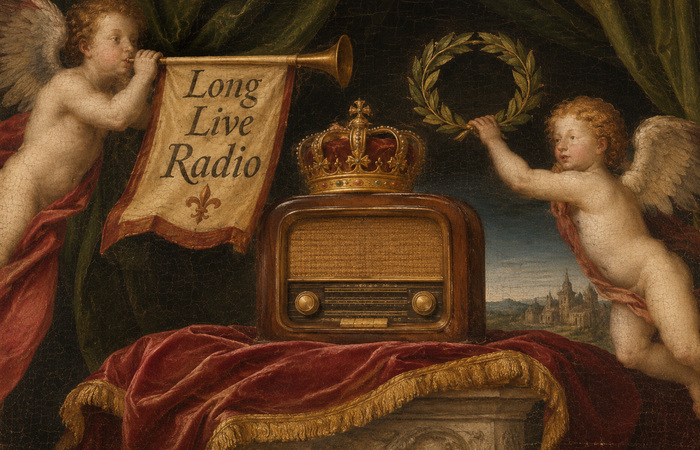
Radio’s Still Got It
Who said radio was dead? The latest RAJAR figures are out and despite the endless choice of podcasts, streaming services and social media – radio is enjoying something of a renaissance.
A record 51 million people now listen to radio each week, up 2% year-on-year, proving the nation’s love affair with the airwaves is far from over. Commercial radio continues to lead the charge, attracting 40 million weekly listeners and commanding 55.7% of all listening, compared with the BBC’s 41.9%.
So, who’s riding high, who’s losing listeners and who’s making the biggest noise? Here’s our round-up of the latest winners, surprises and talking points.
THE BREAKFAST CLUB: SARA’S SERVING UP A STRONG START
There’s a new voice waking up the nation at BBC Radio 2, and it seems listeners are enjoying their morning cuppa with Sara Cox. Having taken over the Breakfast Show hot seat in July, Cox has attracted 6.4 million weekly listeners, with the programme’s audience up 4% year-on-year.
Meanwhile, her Radio 2 colleague Vernon Kay continues to rule the airwaves, hosting the UK’s most listened-to radio programme with 6.8 million listeners each week. Over at Heart, Jamie Theakston and Amanda Holden remain commercial radio’s breakfast champions, entertaining four million listeners, while Capital’s Jordan North, Chris Stark and Siân Welby attract 2.7 million. Greg James is also holding his own on BBC Radio 1, waking up 4.12 million listeners, while KISS Breakfast hosts Tyler West and Chloe Burrows are celebrating a 29% year-on-year audience boost.
It seems the battle for Britain’s breakfast ears is hotter than ever!
COMMERCIAL RADIO: HEART’S STILL GOT THE LOVE
It’s another strong quarter for Global, which has clocked up a record 289 million listening hours, reaching 29.1 million people every week. Heart remains the UK’s biggest radio brand, with more than 13 million listeners, narrowly beating BBC Radio 2, which retains its crown as the biggest individual station with 12.7 million. Capital is also hitting the high notes with 9.1 million listeners, while Smooth attracts 7.5 million.
Over at Bauer, Greatest Hits Radio continues to strike a chord with 6.8 million listeners, with Ken Bruce retaining his title as commercial radio’s most listened-to programme. The Hits Radio Network reaches 6.6 million, while Absolute Radio has grown to 5.5 million.
And there’s good news for nostalgia lovers, with Greatest Hits Radio 80s attracting a record 644,000 listeners and Absolute Radio 00s growing 22% year-on-year. Who needs new music when the old favourites are still pulling in the crowds?
TALK ISN’T CHEAP – BUT IT’S CERTAINLY POPULAR
Speech radio is also giving listeners plenty to talk about. BBC Radio 4 remains the UK’s biggest speech station, reaching 8.7 million people each week, while its flagship Today programme attracts 5.5 million. BBC Radio 5 Live Breakfast is also enjoying a boost, with its audience growing 13% year-on-year to more than 1.4 million.
Meanwhile, Times Radio has increased its audience by 10% to 619,000. It’s also been a winning quarter for talkSPORT, which has scored its highest-ever listening hours following its coverage of the FIFA World Cup. The network now attracts 3.8 million listeners. Whether it’s politics, current affairs or the beautiful game, Britain’s appetite for a good conversation shows no signs of slowing down.
BBC LOCAL RADIO: A TALE OF TWO AUDIENCES
It’s a more mixed picture for BBC Local Radio, where overall weekly reach has fallen 5.7%, from 4.69 million to 4.43 million listeners. However, there are some bright spots. BBC Radio Derby has increased its audience by 23%, while BBC Radio Merseyside is up 22%. BBC Radio Berkshire is also celebrating, with listening hours soaring an impressive 91% and weekly reach increasing 15%. Elsewhere, BBC Radio Leicester has lost 27% of its audience, BBC Radio Gloucestershire is down 26%, and BBC Radio Cornwall has fallen 23%.
Interestingly, despite the overall decline in listeners, total listening hours across BBC Local Radio have edged up slightly.
Fewer listeners, perhaps, but those still tuning in are spending more time with their favourite stations. For broadcast PR, it’s a reminder that local radio remains an important way to reach communities, even as audiences and listening habits continue to change.
ALEXA… PLAY MY FAVOURITE STATION!
And finally, the latest figures show that while our love of radio remains strong, the way we listen is changing. Online listening now accounts for 30.8% of all radio listening, compared with 23.6% for traditional AM/FM.
Smart speakers alone account for 18.7% of listening, while more than a third of commercial radio listening now takes place through internet-connected devices. Whether it’s Alexa in the kitchen, an app on the commute or a trusty radio on the bedside table, listeners are finding new ways to tune in.
THE FINAL WORD
Despite an increasingly crowded media landscape, radio continues to deliver something special: huge audiences, trusted voices and a personal connection with listeners that few other platforms can match. And with a record number of people tuning in every week, it’s safe to say radio isn’t going anywhere.
Long live the airwaves!
Comments are closed.